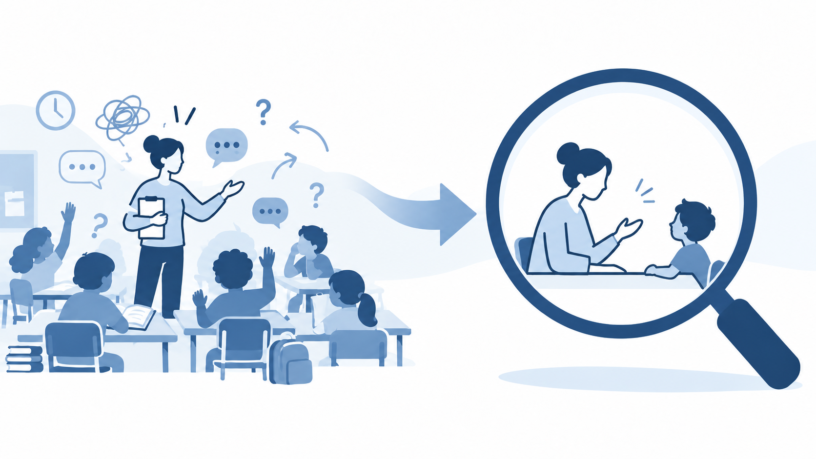
Teaching makes extreme cognitive demands on teachers. Consider Maddie Lampert’s thoughts about a single decision: who should speak next? Richard is struggling to answer a question. Lampert suspects Catherine will be able to answer correctly:
“But what effect would that have on Richard? How would it affect Catherine if I did not let her continue? What effect would either course of action have on what the rest of the class could learn about the math, as well as what they could learn about Richard and about Catherine or about the racial and gender groups to which these students… belonged? (Lampert, 2001, 16)”
Teachers face many such dilemmas, every lesson. Priorities conflict: a detailed explanation may lose students’ attention; an enjoyable activity may obscure key ideas (Kennedy, 2016). Decisions must be made almost immediately: an expectant audience allows little time for reflection. Teachers deal with these demands by forming habits. They come to handle recurring tasks, like managing disruption or settling students into lessons, almost automatically (Hobbiss et al., 2020).
This makes changing teaching while teaching extremely difficult. The lesson already absorbs the teacher: change diverts their attention, causing mistakes elsewhere. Teachers are swept along by existing habits, even when they mean to change. Lessons rarely allow space and time to teach effectively and to change teaching at the same time. We must create this space in training. To do so, effective practice “deliberately distorts the setting in which participants will ultimately perform in order to focus on a specific skill under maximum concentration (Lemov et al., 2012).”
This distortion is critical. Take a training session on non-verbal reminders. In a lesson, a teacher must consider what they’re saying, what to say next, whether students understand, the next task, who’s distracted – and how to respond. To help teachers master using non-verbal reminders, we must strip these concerns away. We give teachers a text to read so they don’t have to choose what to say. They face a single student, so they don’t have to spot who’s distracted. They can focus on refining the target skill: using a clear, positive non-verbal reminder.
It’s hard to teach effectively and improve teaching at the same time – training must create space to focus on a specific skill
This is often misunderstood. Some teacher educators miss the focus on a single skill, equating deliberate practice with microteaching or role play. (Microteaching is rehearsing a condensed lesson, or part of a lesson. Role play is rehearsing a specific situation.) But in microteaching and role play, teachers teach – rather than practising a specific skill in a simplified situation. They may gain fresh insights (in particular, about how hard teaching is!), but they are unlikely to master specific skills.
Some teachers complain that practice “feels unrealistic.” But true realism – practising multiple skills at lesson speed – is just as hard as teaching. We begin with simplified, unrealistic practice, so teachers can master a single skill. Skills are building blocks: having mastered one, teachers can practise another, combining them to move towards realism. For example, in a session on non-verbal reminders, teachers first practise giving them in isolation, then practise spotting a distracted student and giving a reminder. (We can also add authenticity if it doesn’t distract from the target skill. For example, practising in a teacher’s own classroom feels authentic, but doesn’t change the focus.) Deliberate practice is deliberately unrealistic, to help teachers master specific skills.
Simplifying the classroom situation is central to deliberate practice
In planning a lesson, the key question is what we want students to think about (Willingham, 2009).* In planning training, the key question is what we want teachers to practise – and what we must strip away to make this possible. We’ve discussed a classroom management example (practising non-verbal reminders), but this applies to any skill. Take lesson planning. Just as classrooms are busy with tasks, decisions and demands, lesson planning is busy, as teachers consider objectives, activities and resources. To help teachers improve, we simplify this, focusing on one skill. For example, if we want teachers to get better at setting objectives, we focus on that – and not the activities and resources those objectives require. Once teachers can set objectives well, we can focus on other lesson planning skills. The table below offers further examples. The first column shows the target skill; the remaining columns show ways to simplify reality to practise that skill.
| If we want teachers to practise… | We give them… | So they can focus on… | And not… |
| Responding to interruptions | A text to read | Responding to the interruption | What they are teaching |
| Giving sanctions | A scenario which clearly merits a sanction | What to say | Whether to give a sanction |
| Deciding whether to give a sanction | A decision to make | Whether to give a sanction | What to say when giving a sanction |
| Writing exit tickets | Lesson objectives | Writing exit tickets which fit the objectives | Deciding the lesson’s purpose |
| Reviewing exit tickets | Exit tickets with student answers | Reviewing the exit tickets | The purpose of the assessment |
| Modelling the school’s values | A value to model and a situation to model it in | Demonstrating and explaining the value | When and what to model |
Would we normally expect teachers to write exit tickets without setting objectives? No. But if we want teachers to get better at writing exit tickets, we must let them focus on it. Writing objectives matters – we can focus on this in another session. Ensuring objectives and exit tickets correspond matters too – but teachers must master each skill individually if they are to do both together.
Conclusion
Effective training strips away concerns so teachers can focus on the target skill. This may seem strange; initially, teachers may not like it. We can discuss the cognitive load burdening teachers to help explain why. But we must no compromise: in desining an effective training session, we must simplify the situation, designing a practice activity which strips away other concerns so teachers can focus on the target skill.
This is an adapted excerpt from my new book, Improving Teaching, which you can order now.

* Strictly, the question is what our lesson will make students think about.
References
Lampert, M. (2001). Teaching problems and the problems of teaching. Yale.
Kennedy, M. (2016). Parsing the practice of teaching. Journal of Teacher Education, 67(1), 6-17.