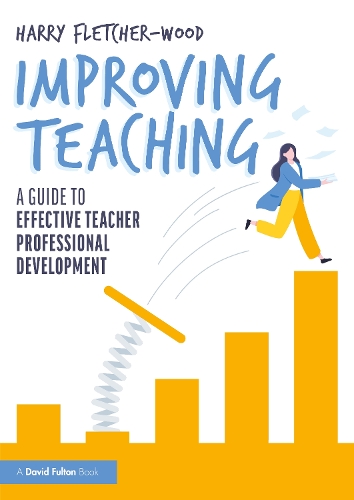
TL/DR: Improving Teaching: A guide to effective professional development is available to pre-order now.
Two things make it hard to improve teaching. First, teaching itself is extremely hard. Second, helping teachers get better is harder still.
Teaching well – encouraging, supporting, challenging and cajoling thirty unique individuals to simultaneously learn and retain new, meaningful ideas will never be easy. This means teachers can always get better.
But we struggle to help them improve. When researchers study teacher growth – how much more students learn with an experienced teacher, as opposed to a novice – they find that teacher effectiveness jumps initially. That makes sense: think back to everything you struggled with in your first week of teaching. Think how fast you learned.
Within two or three years however, teacher growth stagnates. Teachers still get better – but much, much more slowly (Kini and Podolsky, 2016). Indeed, in an average year, three in ten teachers improve, five stay the same – and two get worse (TNTP, 2015). If most teachers don’t get better most years, professional development can’t be making much of a difference.*
Moreover, when we ask teachers what they think of the professional development they receive, most say it isn’t doing much good. Teacher Tapp has found that:
- Only 4 in 10 teachers believe their school’s professional development improves teaching.
- Most teachers wouldn’t mind if professional development stopped for five years.
- One in five says they’ll get better anyway.
- One in five they wouldn’t have changed anyway.
- Two fifths expect their growth to be slightly worse.
- Just a fifth expect it to be significantly worse.
- Given an imagined choice between perks including free food, unlimited photocopying, or an extra free hour each week, half of teachers choose the extra hour; 17% the free food. Just 7% want three days’ professional development of their choice.
When free food is more tempting than help to teach better, we – teacher educators – have a problem.
We could comfort ourselves that things are different in our school – but it may be false comfort. Senior leaders are twice as likely as classroom teachers to think their school’s professional development is working.
Teachers’ perceptions mirror the evidence around teacher growth: most professional development doesn’t help.
Improving Teaching shows how we can do professional development better. It’s a step-by-step toolkit for anyone whose role involves helping teachers to improve. It’s built on a decade’s experience: leading professional development, researching how to do it better, and training leaders to improve their schools at Ambition Institute and Steplab.
The book addresses four building blocks for effective training – how we can:
- Make our professional development programme coherent
- Lead effective training
- Coach individual teachers
- Help teachers to change
Then it looks at how we can best use these building blocks, through three elements of an effective school improvement programme – how we can:
- Identify the most promising changes
- Make lasting, meaningful change
- Evaluate impact
Whatever your role – coach, professional development lead, head of department, school or trust leader – if you are working on teacher development, Improving Teaching should help. Each chapter is designed to explain the ideas and help you make them work, through step-by-step guidance, worked examples, a checklist and a case study. The final chapter offers further tools and advice for leaders in specific roles.
You can order the book here.
You can learn more about the ideas informing it in past posts on teacher development.
I’ll write a more about the ideas in the book, and how it has come together, over the next few weeks.
As I emphasise in the book, I’m still learning. I’d love to know what you think of the book, how you use it, and how it could be improved.
References
Kini, T., Podolsky, A. (2016). Does Teaching Experience Increase Teacher Effectiveness? A Review of the Research. Learning Policy Institute.
The New Teacher Project (2015). The Mirage: Confronting the hard truth about our quest for teacher development, 13.
* I cite US data here, first, because multiple studies have been conducted; second, because these studies draw on two kinds of data we tend to lack in England: data linking teachers to the learning of the individual students they teach, and external assessments across consecutive years, which show growth in learning.