They needed to create a ‘common vocabulary’ to describe the elements of good teaching (p. 175)”
They needed a kind of playbook, an understanding of what made the best teachers great so that they could help the merely ordinary get even better…. an organised breakdown of all the little details that helped great teachers excel (p.181)”
In 2013, Doug began crafting ‘Taxonomy 2.0,’ a second edition of Teach Like a Champion… (Elizabeth Green, Building a Better Teacher, p. 278)
Some problems are ‘endemic’ in schools: at some point in every career (or day), all teachers answer “What do you do when a student gives up and simply won’t try? How do you know what the student who hides silently in the corner is learning (p.6)?” Teach Like a Champion is built on a conviction that “It shouldn’t take a dozen years of brutal trial and error, suffering, and fatigue” for teachers to find and adopt workable answers (p. 6). In 2010, Lemov shared the best solutions he had found; revision, rethinking and reorganisation have led to version ‘2.0,’ published this month.
(This is the kind of review I like: an extended analysis; those who prefer more direct (briefer) reviews can find mine here).

Do [students] revise and improve their thoughts, or leave them in draft version once they’ve initially thought them through? (p. 235)”
In contrast to ‘ideological’ and ‘research’-based guidance, Lemov describes his work as ‘data-driven,’ generating “its knowledge from teachers: it’s the process of showing teachers a picture of themselves at their very best (p.8).” Even before the first edition was published, the ‘taxonomy’ of techniques had become “a kind of recursive process. Doug… sent a technique out into the world, and then the world sent it back: the same idea, refined (Green, p.191).” Teach Like a Champion 2.0 benefits from five more years’ learning and refinement. Many aspects have been reconceptualised, most notably ‘Check for Understanding,’ which has grown from a technique to an entire ‘Part,’ incorporating ten techniques. The book is now formed around four pillars:
- Check for Understanding (what have students learned?)
- Academic Ethos (how can I make my teaching rigorous?)
- Ratio (how can I ensure students are doing as much working and thinking as possible?)
- Behaviour and culture (how can I create a climate which promotes learning?)
Each part includes a number of techniques (sixty-two in total, up from forty-nine in 2010). These techniques are explained, rationalised and realised through “concrete, specific, actionable advice” like “Show your directions matter. Stand still (p.8).”
Perhaps the most fundamental change to Version 2.0 has been addressing an imbalance which led some teachers to lose sight of learning in their focus on classroom culture. Elizabeth Green describes many charter schools as having “Cracked the code of how to get kids to behave” through techniques like those in Teach Like a Champion, but found “They were missing a vital academic ingredient.” She quoted one principal describing a teacher as being ‘incredible’ at managing classrooms: “He invests kids wholeheartedly in what he wants kids to do… But what we really had to work on is, ‘what are you asking kids to actually do?’ (Green, p. 229)” Version 2.0 seeks to ensure that, within the prerequisite climate for learning, every moment is spent helping students get smarter. Pursuing this, Lemov makes robust, nuanced arguments for demanding tasks, challenging reading and deep knowledge of topics. New techniques like ‘Show Me’ (think hinge questions) and ‘Show Call’ are designed explicitly to promote analysis and refinement in the classroom; the centrality of academic depth runs throughout the book.
Part of teaching a technique well is to describe for learners in no uncertain terms what the skill involves, what it looks like, and how to do it (Lemov et al., Practice Perfect, p.86)”
I’ll exemplify this with ‘Technique 39: Show Call:’ “Create a strong incentive to complete writing with quality and thoughtfulness by publicly showcasing and revising student writing (p. 290).” I choose this example partly because it’s new to Version 2.0 and partly because although I had been doing it, the book showed me the approach and its possible applications afresh. Lemov opens by explaining a problem I’ve experienced – great class discussion succeeded by relatively mediocre writing – and a possible solution: projecting a student’s work and evaluating it as a class. Lemov discusses questions teachers must consider: What kind of work to show? When in the lesson? How many students’ work? He goes on to offer several ways to make use of the insights gained, by asking to students to revise their answers immediately. Next, Lemov offers phrases teachers might employ and ways to manage the process without unduly stressing students. Finally, he suggests four ways to do this without a visualiser. Within this text, two videos show the technique at work (example resources are provided for other techniques). The specificity of the book’s videos and examples, such as poorly-framed learning objectives, is a powerful way of overcoming one barrier to implementation: lack of clarity how to do so.
The book’s power rests upon meticulous observation of the psychology and dynamics of teaching, classrooms and students. Explaining why teachers should ‘Reject Self Report’ (of student understanding), for example, Lemov highlights the phrase: “Everyone got that?” and identifies exactly why students are unlikely to respond in the negative: it’s incredibly hard to 1) identify a knowledge gap, 2) concisely describe it and 3) do so in front of peers, in the couple of seconds a teacher may give. I particularly enjoyed an excerpt from the (notional) Survive Like a Champion: 50 Student Techniques for Keeping Above Water When You’re Not Keeping Up: if you don’t know the answer to a question, try the “kitchen sink” (everything you know), “bait and switch” (answer the question you wish you’d been asked) or the “heartfelt topic” (“Look, I don’t know what iambic pentameter is either, but trust me, if you start talking about justice and fairness in the poem, your teacher’s going to forget all about it, whatever it is (p. 104)).” I find the close examination of the details of effective approaches a huge aid in rethinking my own teaching.
Doug always emphasized that teachers should use these evolving techniques only if they made sense (Green, p. 278).”
Two frequent criticisms of Teach Like a Champion are that it creates passive, robotic students and that numbered, simplified teaching techniques deskill teachers. Outside the USA, a third reservation is the ‘Americanness’ of the techniques.
Lemov’s approach to students appears paternalistic, not authoritarian: teachers must often make decisions in pursuit of students’ best interests, rather than their immediate preferences. Through helping teachers choose wisely and execute their choices effectively, Lemov hopes they will support students to exceed what they would otherwise achieve. He is emphatic that high behavioural expectations are a means, not an end: students “Rely on teachers to create [focused] environments if they are to aspire to academic greatness…. An orderly room must be orderly to allow academic rigor to thrive. Students must be silent so that a classmate may speak in a climate of respect (pp. 384-385, emphases original).” He uses this relaxed photograph of students reading Harry Potter to exemplify the freedom teachers with confident control of their classrooms can offer their students.
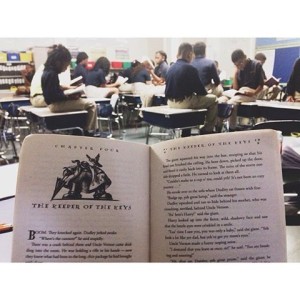
(Lemov discusses this picture further here.)
Arguing Teach Like a Champion is a straitjacket that deskills teachers appears wildly off-target: this is a recipe book “about the tools of the teaching craft (p.2),” not an instruction manual. Lemov provides a variety of suggestions rather than promoting conformity: “Not every teacher I observed used every technique I described… I found that great teachers came in every stripe and style (p. 3).” Teachers may choose to adopt techniques “but almost right away, great teachers start to adapt and adjust anything good; they make it fit their own unique style and approach, their setting and students (p.5).” In conceiving of teachers “not just as recipients and implementers of the field’s knowledge but as creators of it (p.8)” and emphasising that “the art is in the discretionary application of the techniques (p. 12),” Lemov seems to venerate highly-skilled professionals. The detailed analysis and discussion of effective techniques he offers is a prerequisite for teachers seeking excellence.

If we want more videos of our own countries’ teaching, we have to make them.
American names and examples can inhibit the export of these techniques: who really wants to adopt ‘Pastore’s Perch’ or demonstrate the ‘J Factor?’ “The names may seem like a gimmick at first, but they are one of the most important parts (p.4),” something Lemov explained in Practice Perfect: naming skills “creates a language for your team,” helps shape skills, and becomes a “powerful shorthand for talent development (pp. 66-7).” I overcame my reluctance to use these names with colleagues because no one has offered better ones: we are all (I hope) aware of ideas like ‘affirmative checking,’ using the term as a shorthand (rather than ‘that thing when you…’) makes it easier to discuss, analyse and develop. As for videos, I told colleagues I knew of no Swedish equivalent; in the UK, although there are no doubt collections within schools, I know of only two outside them: one academy chain which I hope may one day start sharing its work more publicly and an organisation at which I’m about to start working and which is planning a more public forum for its videos.
If I were to suggest improvements for version 3.0, they would lie beyond these tired and, in my view, inaccurate criticisms. Two crucial aspects of good teaching are missing: wellbeing and self-improvement. While not teaching techniques, to me maintaining wellbeing and managing time are essential ‘back office’ functions enabling teachers to deploy teaching techniques successfully over decades (not years). In contrast to Teach Like a Champion, Teaching as Leadership, a work of similar aims and derivation: includes as two of its six pillars advice on ‘Continuously Increas[ing] Effectiveness’ and ‘Work[ing] Relentlessly.’ The latter sounds intimidating, but it includes a discussion about ‘Sustaining This Work Over Time,’ noting that “Burning out does not help you or your students (p. 219),” approvingly quoting a teacher who stopped taking work home, and encouraging thought “about what other priorities you should have in your life and fulfilling those (p. 220).” Perhaps there’s scope for a follow-up project: what’s it actually like being a ‘champion’ teacher? How do they keep going, year after year? How do they get better? Finally, while I believe we can never stop refining our use of these techniques, we must do so allied with (based upon) an ever-deepening understanding of subject knowledge, something which is implicit in Teach Like a Champion, but I’d like to see covered further.
Teaching is the best and most important work in our society. Those who do it deserve to experience constant growth and learning. That, after all, is what we wish for our students (p. 4).”
When I began reading this, I was only weeks away from a role outside the classroom. But I still found myself adapting, as I realised, for example, that I had only ever planned for error tacitly. Teach Like a Champion 2.0 has something for everyone:
If you’re a teacher near the beginning of your study of the craft of teaching, my aim is to help you become one of those teachers who, for a long and distinguished career, unlocks the latent talent and skill waiting in students, no matter how many previous efforts have been unsuccessful.”
“If you are a master teacher already, I hope a discussion of tools and their applications, the framing of a vocabulary for talking about the critical and sometimes overlooked moments of your day, will inspire you not only to refine your craft but also to love doing so… I assume that in many cases this book may describe things you already know and do. That’s great by me, and in that case, my goal is to help you get a little better at them, perhaps seeing useful applications and variations you haven’t considered.”
From the perspective of someone who is no longer a novice, and nowhere near a master, I could see both aspects. This book is a masterpiece: while some readers will dispute aspects of it, I suspect none will find a better guide to great teaching.
References
Doug Lemov, Teach Like a Champion 2.0: 62 Techniques That Put Students on the Path to College
Elizabeth Green, Building a Better Teacher
Doug Lemov, Erica Woolway and Katie Yezzi, Practice Perfect, a fascinating work on training teachers (or anyone): I’ve reviewed using it here.
Steven Farr, Teaching as Leadership: The Highly Effective Teacher’s Guide to Closing the Achievement Gap

(All quotations are from Teach Like a Champion 2.0 unless otherwise indicated).
Next week, I will write about a technique from the Teach Like a Champion 2.0 I’ve been trying to implement for a while – ‘The Art of the Consequence.’
Related posts
My visits to Uncommon classrooms, time with Uncommon school leaders and training
Trying to put 100% into practice.
Using Uncommon’s ‘leverage observations.’
Reblogged this on The Echo Chamber.
Reblogged this on #TeachGeog.
I’m sure I speak for the teaching community as a whole when I thank you for writing this review. I very much look forward to getting my hands on a copy of my own!
The two topics that you suggest are lacking from Lemov’s work are crucial, I feel. The very best teachers are those that can manage their time effectively & those which are reflective magpies. Everything else, like the good quality teaching that Lemov promotes stems from these two core qualities. It is a glaring omission on Lemov’s part to offer up a huge chunk of good quality ‘stuff’ without providing the hard-pressed teacher with a meaningful strategy for implementing it. Heck, I know people in the profession who feel that they would need to devise a strategy to find the time to read it!
Thanks again Harry!
A book that looked at how master teachers sustain themselves would be very useful indeed. A project for you Harry?
I hadn’t thought of that, but it’d be a fascinating (and fun) project. One for about two thirds of the way back in the ‘good ideas’ filing cabinet.